Understanding Fermentation Tank Capacity Fundamentals
Fermentation tank capacity directly impacts your brewery's production efficiency, batch consistency, and operational costs. As procurement professionals and project managers, you need to consider both current output requirements and future expansion plans when selecting tank sizes. The right capacity ensures optimal yeast performance, consistent flavor profiles, and efficient space utilization in your facility.
Industry standards categorize fermentation tanks by working volume (typically 60-80% of total capacity to allow for krausen space). For craft breweries, common sizes range from 5HL to 50HL, while industrial operations may require 100HL to 500HL vessels. Our 5HL Brew house system demonstrates how properly sized equipment can streamline smaller-scale operations without compromising quality.
This table illustrates how tank capacity requirements scale with production volume. Note that actual working capacity should account for 20-30% headspace to prevent overflow during active fermentation phases.
Key Factors in Calculating Your Ideal Capacity
Production Volume Analysis
Start by calculating your annual production target and break it down to weekly batches. For example, if you aim to produce 2,000HL annually with 50 working weeks, you'll need capacity for 40HL per week. With 2-week fermentation cycles, you'd require approximately 80HL of tank space to maintain continuous production.
Beer Style Considerations
Different beer styles require varying fermentation times and tank utilization:
- Lagers: 4-8 weeks fermentation + lagering
- IPAs: 2-3 weeks primary fermentation
- Sours: 3-12 months in specialized tanks
- High-gravity beers: Extended fermentation periods
These variations mean your tank capacity must accommodate your product mix. A brewery specializing in lagers will need 2-3 times more tank space than one focusing on ales with the same production volume.
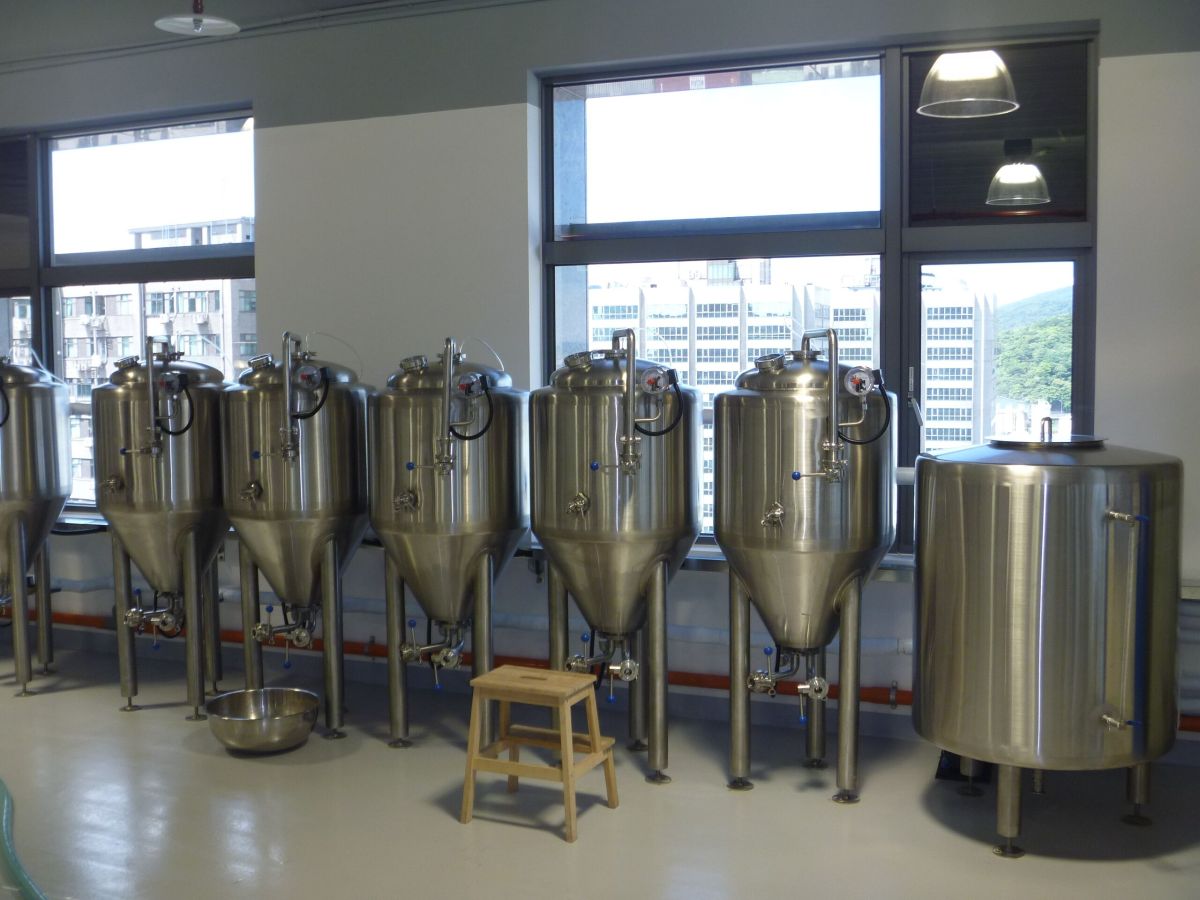
Facility Constraints
Physical space limitations often dictate maximum tank dimensions. Consider:
- Ceiling height (vertical tanks vs. horizontal)
- Doorway and access point dimensions
- Floor load capacity (1HL = approx. 100kg when full)
- Utility connections (spacing for cleaning and maintenance)
Optimizing Tank Configuration for Efficiency
Strategic tank configuration can maximize your existing capacity. Many breweries implement these approaches:
The optimal setup often combines several configurations. For instance, pairing our 5HL Brew house with larger fermentation vessels allows for pilot batches while maintaining production scale.
Cost-Benefit Analysis of Tank Sizing
When evaluating capacity decisions, consider these financial factors:
- Capital costs per HL typically decrease with larger tanks (20HL tank costs 30-40% less per HL than 10HL)
- Labor efficiency improves with larger batches (1 operator can manage multiple large tanks)
- Energy costs per HL are lower in properly sized tanks
- Overcapacity leads to idle equipment and tied-up capital
A balanced approach considers 3-5 year growth projections. Modular systems allow gradual expansion without excessive initial investment.
Implementation and Scaling Strategies
Phased Expansion Approach
Many successful breweries implement capacity in stages:
- Start with core capacity for 60-70% of projected year 1 demand
- Add 20-30% capacity in year 2 based on actual sales
- Plan major expansions at 3-5 year intervals
Future-Proof Design Elements
When installing initial tanks, incorporate:
- Standardized connections for easy additions
- Extra utility capacity (chilled water, CO2, etc.)
- Space planning for additional tanks
- Control systems that can expand with new equipment
Frequently Asked Questions
How much headspace should I leave in fermentation tanks?
Industry standards recommend 20-30% of total capacity for krausen formation, with 25% being optimal for most ale fermentations. High-krausen beers like wheat ales may require up to 35% headspace.
What's the minimum number of tanks needed to start production?
For continuous operation, you'll need at least 3 tanks per beer style in your regular rotation - one fermenting, one conditioning, and one being cleaned/refilled. This allows for 2-week fermentation cycles without downtime.
How do I calculate total capacity needed for seasonal demand spikes?
Analyze your peak monthly sales (typically 30-50% above average) and calculate the additional tank weeks required. Many breweries maintain 10-15% extra capacity or adjust production schedules 3-4 months before peak seasons.
Conclusion and Next Steps
Calculating the right fermentation tank capacity requires balancing current needs with future growth, understanding your product mix, and optimizing facility constraints. By following the methodologies outlined above, procurement professionals and project managers can make informed decisions that maximize brewing efficiency and ROI.
For personalized capacity planning assistance or to discuss specific equipment configurations, contact our brewing solutions team. We'll help you design a fermentation system tailored to your production goals, whether you're outfitting a new facility or expanding an existing operation.
Get real-time quotes
Interested? Leave your contact details.